
Lucy’s March 2026 Cheese of the Month: Pi
The north part of Spain produces some excellent cow’s milk cheeses but as you travel further south and the land becomes drier, rockier and hotter the cheeses are virtually all sheep and goat milk. 50km south of Madrid and you come into Manchego country where cheeses must be made from the milk of local Manchega sheep to gain the name. We probably all know the sweet milky taste of a Manchego Fresco (young and fresh) and the bolder taste and granular chew of Manchego Curado or Viejo (mature and extra mature) but I was stopped in my tracks by Pi on Brindisa’s new stall at the Market. Made from the same milk, made in the same the area but this cheese is a world apart in both flavour and texture to its more familiar cousin.
Visually, it reminded me of a little artisan Caerphilly with its dark grey/blue rind and its clean white paste inside. Produced on the Hualda Farm near Toledo this is a raw sheep milk cheese with traditional rennet and is called ‘Pi’ (the Ancient Greek for the letter P). ‘P’ stands for the Penicillium Roqueforti added to the starter culture. This is the culture added to all blue cheeses and if pierced grows those familiar blue pathways inside cheese.
This cheese is not pierced, so the only hint of the growth of the mould is the dark inky blue colour speckled over the rind, but the influence on the flavour for me is dramatic. The silky creamy texture of the paste with its milky, lactic, buttery flavour, marrying with the mushroom hint of the rind was magic enough, but at the end of my mouthful there was an intense savoury flavour that I would expect from a cheese much older than its 4-6 weeks. And there we are – that is what that flavour is – it is a blue cheese, but don’t panic non-blue lovers – it is not a blue cheese! The Penicillium Roqueforti brings a roundness and boldness to what is quite a young sheep cheese. It’s pretty, it’s delicate and the flavour is robust – all at the same time.
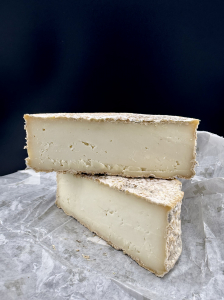
Pi: it’s only blue on the outside
Make sure you get it out of the fridge at least 1 hour before eating as the flavours are completely different after time at room temperature. I enjoyed it with herby red Vermouth from Kevin at Vinagogo and it was excellent with a full-bodied Riesling. Food-wise it was fab with a charred baby gem but also married well with sun-blushed tomatoes and was gorgeous with sourdough. The firm and springy texture when young becomes almost spreadable with time. This cheese is ‘quietly very exciting’.
Brindisa imports all things Spanish, and their cheese range is huge, but they are specialising in sheep milk cheese for us. Sheep’s milk is the backbone of Spanish cheesemaking. Spain is home to many rare and traditional dairy breeds, each producing milk with its own character. Brindisa feels that by championing these cheeses, they will help preserve the knowledge, culture and biodiversity behind them. They want to really show them off and teach us about them. Visit their stall on Sunday and start your Spanish sheep cheese journey.