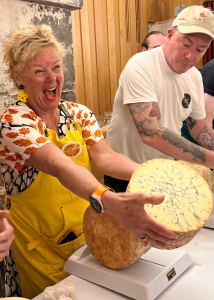
When we started the Chiswick Cheese Market in 2021, we set out to support cheese makers and cheese mongers but we had no idea what an adventure it would turn out to be. The market was founded and is run by a group of impassioned volunteers who donate their time and the proceeds of the market to charity. To date we have given £75,000 to support various causes.
Our championing of artisan cheese makers quickly garnered the attention of the Academy of Cheese, the UK’s professional accreditation association who are dedicated to fostering cheese knowledge, cheese education and careers in cheese.
We have collaborated with the Academy to offer the Chiswick Cheese Market Grant to help educate, mentor and promote the blossoming of artisan cheesemaking throughout the United Kingdom. To date, we have given 12 grants and about to offer 3 more for 2026.
One of the most important events in the UK artisan cheese-making calendar is the Academy of Cheese’s Affineur of the Year Awards. An affineur is akin to a ‘cheese-whisperer,’ an expert in the art of maturing and ageing cheese, otherwise known as affinage. Great affinage is equal parts alchemy, understanding and collaboration between the cheesemaker and cheesemonger and the elements.
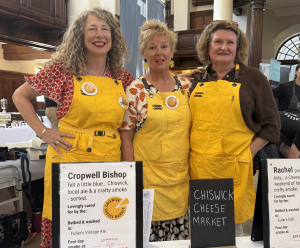
A highly competitive contest, the Affineur of the Year joins the forces of the educators, cheesemakers and the affineur and we have been proud sponsors of the Hard Cheese category for three years. The entrants are attempting to push boundaries with the cheeses, explore new techniques and showcase their cheese and maturing artistry and skill. Historically, several new cheeses have come out of the competition.
How it works: There are five categories of cheese in the competition. Hard Cheese, Soft Cheese, a Washed Rind cheese, a Crumbly cheese and a Blue cheese. Each participant receives the same cheese made from the same herd, the same batch of milk and made on the same day. They then have the remaining amount of time to implement their ageing and maturing plan. The judges are looking for not only great tasting cheese, but that the method of maturing chosen displays both knowledge and the skill to achieve that outcome.
For the second year in a row, the Chiswick Cheese Market waded into the competition as competitors, not just sponsors. We chose the Cropwell Bishop Stilton – possibly one of the greatest and grandest of British cheeses to see what we could achieve.
Because virtually all cheese is made from the same four ingredients (milk, starter cultures – beneficial bacteria, rennet and salt) how, when and at what temperature and to what degree these ingredients are added define the cheese. To make Stilton, pasteurised cow’s milk is inoculated with starter cultures, rennet and Penicillium roqueforti at 32C. The curds are drained of the whey, salted and chopped by hand and then placed into tall cylindrical hoops. The curds are drained and compacted by gravity and not pressed which gives Stilton its slightly crumbly texture.
The curds have to develop before any oxygen is introduced (oxygen is what activates the Penicillium roqueforti and produces the blue-mould veining), so the sides of the cheeses are smoothed by hand to seal out any oxygen. The cheeses are kept in humidity-controlled refrigerated room for 10 days at 10-12C and 85% humidity for 3-4 weeks. They are turned daily for the first 10 days to ensure even moisture throughout the cheese. Only after the cheese is fully-formed is the cheese mechanically rodded to introduce oxygen and create the beautiful, distinctive blue-veining. The Stilton is aged for another 8-10 weeks in a temperature and humidity controlled environment to encourage the blue-veining throughout the cheese and develop the rind.
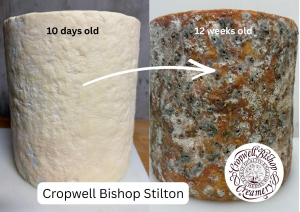
We had our Stilton ‘Gotcha Day’ when she – yes, she was a she and she was our Cheese Baby – was only ten days old and weighed eight kilos!
Our market has developed into a beautiful collaboration with Chiswick and its community and our traders and the wider cheese world. We wanted to celebrate that cooperation in our cheese. Our idea for our Cheese Baby was to invite her down from Nottingham (where she was born) for a pint and a cheeky fag at the George IV on Chiswick High Road.
We turned and washed the 8k wheel of cheese in local Fullers’ Vintage Ale (8% alc) provided by the George IV pub for the first eleven days keeping the humidity high to encourage mould growth. Stilton is not a washed rind cheese but we wanted to see how the ale would influence the flavour. Then we pierced her by hand – it was painful for us but it was for a good cause: the blue veins. After we had her for four weeks, we escorted her to London Smoke & Cure who are one of the fantastic traders at our market and are master smokers. They smoked her whole for four days (Stilton is regularly smoked but after it has been fully matured and then, only in smaller pieces, not whole) before she came home to Chiswick where we kept a watchful eye on the temperature and humidity. What we lacked in depth and breadth of knowledge and experience, we more than made up for with tender, loving daily care from a team six doting Cheese Mamas. It takes a village to raise a cheese.
The Affineur of the Year Awards took place at Christchurch Spitalfields this year and is open to the public. Along with the prizes for best cheese which is judged on technical skill, innovation and planned outcomes, there is also the People’s Choice for each cheese. Everyone present votes for the People’s Choice, the judges, the cheesemakers, the cheesemongers and the public. It is awarded to the cheese people most liked to eat, that tastes the very best.
We were thrilled and astonished to see how much of the glorious blue veining we had achieved. The ale lent a Marmite-y taste which complimented and enhanced the blue. The paste was creamy and the smoking lent a ‘bacon and Stilton toasty’ taste. Hugely enjoyable and very satisfying to us, nascent affineurs as we are.
Dear reader: we won the People’s Choice Award for our Cheese Baby! Oh, Cheese Baby, we’ll eat you up, we love you so!